
Za’abeel Duplex Penthouse: Smart Home Integration for Modern Luxury Living
Executive Summary
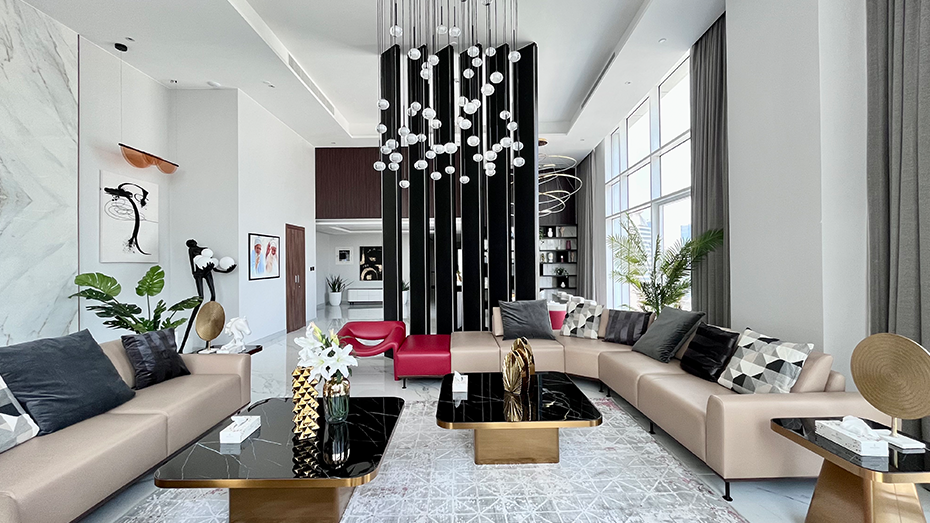
A contemporary duplex penthouse in Za’abeel—designed around principles of minimalism and refined luxury—required a smart home system that would remain completely invisible to its elegant aesthetic while delivering seamless control over the residence’s complex environmental and entertainment systems. The penthouse’s bipartite layout, combining private retreat spaces on the lower floor with expansive social areas and pool deck on the upper level, demanded automation architecture that understood the distinction between personal sanctuary and entertaining venue. Prysmedge integrated a KNX/IP backbone with Crestron scene management, DALI lighting coordination, and multi-zone climate control that honors the owner’s design vision while enabling sophisticated residential automation. The result: a residence where technology serves the lifestyle, not the reverse.
The Challenge
The Za’abeel penthouse presented a deceptively complex integration challenge masked by its apparent simplicity. The owner’s design philosophy—minimalism and contemporary restraint—created a fundamental tension with smart home deployment:
Aesthetic Integration
The residence embraces a carefully curated natural colour palette of neutrals and tropical tones, with rich materials (wood, marble, onyx) seamlessly integrated throughout. Every visible element serves the design narrative. Traditional smart home infrastructure—visible control panels, multiple remote controls, tangible interface hardware—would directly contradict this intentional minimalism. The system could not announce its presence through visible technology; it had to become the invisible backbone enabling the lifestyle.
Functional Complexity Behind Minimalist Design
Despite its apparent simplicity, the penthouse contains genuinely complex functional requirements:
- Duplex Layout Separation — Lower floor (bedrooms, home theatre) requires intimate, private automation; upper floor (dining, living, pool deck) demands flexible entertainment control
- Multi-Zone Climate Management — The residence spans substantial square footage with dramatically different thermal requirements: bedroom sanctuaries requiring precise temperature stability, living spaces accommodating 20+ guests during entertaining, outdoor pool terrace with variable occupancy
- Lighting Nuance Across 12+ Zones — The natural materials and neutral palette are highly responsive to lighting quality. Poor lighting coordination would destroy the intended ambiance; exceptional lighting would be invisible and feel like the space’s natural character
- AV Integration Without Clutter — A home theatre on the lower floor and entertainment capabilities throughout upper social spaces demanded seamless source routing and scene management without visible infrastructure
- Pool Terrace Automation — The expansive outdoor entertaining deck required motorised shading, ambient lighting, water feature control, and climate management—all coordinated with indoor spaces and weather conditions
Owner Lifestyle Requirements
The owner’s dynamic family lifestyle demanded the system serve three distinct operational contexts:
- Private Retreat Mode — Bedrooms and home theatre as peaceful sanctuaries with automatic climate, personalized lighting, and entertainment isolation
- Daily Living — Dining, living, and home office spaces requiring intuitive control, occupancy-based automation, and seamless transitions throughout the day
- Entertainment Mode — Hosting guests on the upper floor and pool terrace with coordinated lighting, AV, climate, and outdoor amenities creating a unified entertainment environment
The system had to transition seamlessly between these modes without manual reconfiguration.
Material Sensitivity and Lighting Challenges
The penthouse’s commitment to natural materials and careful finishes created specific technical constraints:
- Marble and onyx surfaces are highly reflective; improper lighting creates glare and undermines the intended warmth
- The neutral palette is defined more by subtle tonal variation than colour; lighting quality directly impacts whether the space feels warm or cold
- Wood finishes require specific colour temperature ranges to showcase their natural warmth
- Floor-to-ceiling windows with panoramic city views mean occupants are sensitive to any visible automation hardware (motorised shading systems, visible sensors, or lighting fixtures that break the visual line)
The Solution
Prysmedge designed an automation architecture prioritizing invisibility while delivering comprehensive environmental and entertainment control:
KNX/IP Backbone with Distributed Intelligence
The foundation is a KNX/IP network spanning the entire residence, with intelligence distributed across zones rather than concentrated in visible hardware. This approach eliminates the need for centralised control panels and allows automation to operate at the subsystem level while remaining coordinated globally.
Lighting Strategy: Quality Over Quantity
Rather than maximizing fixture count, the lighting design prioritized fixture quality and strategic placement:
- Recessed DALI-Addressable Fixtures — All lighting integrated into ceiling planes, becoming part of the architectural design rather than decoration. 120+ individually addressable fixtures enable granular scene control without visible dimmer panels or multiple remote controls
- Colour Temperature Coordination — Automated colour temperature adjustment (3000K–5000K range) aligns with natural light throughout the day, supporting circadian rhythm alignment while maintaining the warm material aesthetic
- Indirect Lighting Strategy — Emphasis on indirect light sources (uplighting, soffit lighting, accent illumination) that reveal material qualities rather than creating visibility
- Scene-Based Control — Six core scenes (morning, working, entertaining, dining, cinema, evening) accessible via single Crestron touchscreen or mobile app
Climate Control: Zoning Without Visible Infrastructure
The Daikin VRF system provides independent temperature control across five distinct zones, invisible to occupants:
- Master Bedroom & Guest Suites — Precise temperature stability (±1°C) with occupancy-based scheduling
- Living & Dining Spaces — Adaptive zoning that adjusts based on entertainment mode activation
- Home Theatre — Dedicated conditioning (lower temperature, precise humidity) for equipment performance and extended occupancy comfort
- Pool Terrace — Spot cooling via radiant systems coordinated with misting systems during peak sun exposure
- Corridors & Secondary Spaces — Energy-optimised scheduling with occupancy override
Thermostat hardware is minimised—single elegant wall-mounted panels in bedrooms, with primary control via mobile app or Crestron scenes.
Motorised Shading: Coordination Without Complexity
Lutron motorised shading system coordinates with lighting, climate, and entertainment:
- Automatic Scheduling — Blinds follow solar position throughout the day, reducing cooling load during peak heat while maintaining panoramic views during morning and evening
- Scene Integration — Entertainment mode automatically coordinates shading with cinema blackout or outdoor entertaining configurations
- Manual Override — Single Crestron button enables full-open, full-closed, or intermediate positions without exposing technical controls to residents
- Weather Awareness — High-wind conditions trigger automated closure to protect outdoor furnishings
AV Integration: Seamless Multi-Zone Routing
Crestron system manages content routing across four entertainment zones without visible infrastructure:
- Home Theatre (Lower Floor) — Dedicated cinema room with projection, 7.1 surround, motorised screen (integrated into ceiling design), and automated lighting/climate scene triggering
- Dining Area — Elegant wall-mounted display (integrated into architectural millwork) with wireless audio coordination and automated lighting dimming during meals
- Living Spaces — Discreet speaker placement with wireless source switching and mood lighting coordination
- Pool Terrace — Weather-resistant display and outdoor audio with automatic transition to indoor spaces and entertaining mode lighting
All content routing managed through single Crestron touchscreen or mobile app; no visible remotes or control panels.
Control Interface: Hidden Complexity
The resident interface emphasises scenes and lifestyle modes rather than technical parameters:
- Crestron TSW-1050 Touchscreen — Single elegant wall panel in living area offering scene selection, manual overrides, and entertainment controls (concealed when not in use)
- Mobile App — Full control from anywhere in residence or globally for pre-arrival conditioning, remote adjustment, and security automation
- Voice Integration — Hands-free scene activation via supported voice assistants
- Absence Mode — Automated lighting patterns simulating occupancy when residents away
Owner Capability
Daily Living
Morning scene activates gradually brightening lighting (3000K colour temperature), climate pre-conditioning, and ambient background music as the household wakes. The system recognizes weekday vs. weekend patterns, adjusting wake time accordingly.
Working from home mode isolates the home office climate zone, provides task lighting optimization, and mutes entertainment systems. Dining mode dims living space lighting, coordinates dining area displays, and adjusts climate for occupied dining. Evening mode gradually reduces colour temperature, dims entertainment spaces, and prepares bedrooms for sleep.
Entertainment Hosting
Entertainment mode coordinates upper floor and pool terrace: motorised shading opens to panoramic views, ambient lighting shifts to warm entertaining tones, outdoor audio activates, climate maintains comfortable guest conditions, and display systems enable playlist sharing and content selection. Cinema mode (lower floor) operates independently, ensuring home theatre operation doesn’t disrupt upper-floor entertaining.
Remote Management
The owner can pre-condition the penthouse before arrival, adjust climate or lighting from the office, activate security scenes while away, or manage entertainment remotely if entertaining guests.
Outcome
The Za’abeel penthouse demonstrates that invisible automation is the highest expression of smart home design. The system operates entirely behind the scenes, enabling the owner’s lifestyle while preserving the intentional aesthetic vision.
Design Integrity Maintained — No visible control panels, motorised shading hardware, or automation infrastructure disrupts the minimalist aesthetic. Technology serves the design, not the reverse.
Lifestyle Enablement — Complex multi-zone climate, lighting, and AV coordination operates automatically, adapting to occupancy and entertainment requirements without manual intervention or technical knowledge required from residents.
Energy Performance — Occupancy-based scheduling, daylight harvesting, and motorised shading coordination deliver measurable efficiency improvements while maintaining occupant comfort.
Family-Centric Functionality — The system adapts to the owner’s dynamic lifestyle: peaceful private retreats, efficient daily living, and sophisticated entertainment hosting—all managed through intuitive scenes and mobile app control.
The penthouse exemplifies how thoughtful automation architecture can enhance contemporary luxury living without compromising design vision. Every element remains carefully considered, intentional, and in service to the owner’s refined yet functional home within Dubai’s vibrant urban landscape.

Ready to Transform Your Facility?
Let's discuss how we can deliver measurable outcomes, reduce costs, and future-proof your building infrastructure.